Let’s Talk


Oops! Something went wrong while submitting the form.

|---Module:text|Size:Small---| For 25 years, satellites solved one problem: coverage. They connected remote regions, supported mobility, and extended communications where terrestrial networks couldn't reach.
Today, connectivity itself is no longer the differentiator. As services become hybrid - mixing multiple orbit satellite (LEO, MEO, GEO), radio access networks (4G/5G), and fixed networks – the real competitive advantage has moved beyond reach. It's now the ability to seamlessly orchestrate and handing over services across terrestrial and non-terrestrial networks, ensuring reliable interoperability, transparency, and commercial simplicity on top of global coverage.
The satellite industry is moving from a technical conversation to a business conversation. And in that shift, trust becomes part of the product.
Why trust matters more than coverage
Consider a real-world scenario: a pharmaceutical company shipping temperature-sensitive vaccines across Africa. They don't just need connectivity. They need assurance. At every handoff – warehouse to truck, truck to shipping hub, hub to clinic – they want to know: Who touched the shipment? How long was it exposed? Did the cold chain break? Can I prove it?
Traditionally, satellites solved the connectivity piece. But today, that same company also needs visibility across borders, partners, and networks. They need a way to verify that every party in the ecosystem (logistics provider, telecom operator, satellite company, clinic) behaved as agreed. That verification layer is missing. And without it, integrating satellite connectivity into broader mission-critical services remains fragmented and risky.
How roaming solved this problem before
The mobile industry faced an almost identical challenge 30 years ago. Different operators, different countries, different billing systems. How could they let customers roam across networks and still maintain trust, enforce contracts, and settle revenue fairly?
Roaming solved it through three layers: shared billing rules (what each operator charges), legal frameworks (who's responsible when things go wrong), and auditable transaction records (proof of what happened). These layers let operators cooperate without fully controlling one another. The result? A market that grew rapidly because customers could use services globally without worrying about invisible complexity.
Satellites now face the same challenge, but at multiple layers at once – not just billing, but also operational reliability, compliance, and service quality. The solution requires a similarly deliberate architecture. One that's built for interoperability, not isolation.
Orchestration, not just connectivity
Celfocus has spent 25+ years helping the telecoms industry solve exactly these problems: integrating diverse systems, building trust across boundaries, and simplifying fragmentation into workable business models. We've already been active in the satellite domain through TM Forum Catalyst projects and by participating in industry-defining initiatives like TMF Space ODA.
This experience taught us something crucial: telecoms and satellite have far more in common than they differ. Both involve multiple parties, complex regulations, diverse technical standards, and a fundamental need to cooperate across company boundaries.
Our view is simple: complexity reduction is a growth enabler. The companies that win in this market won't be the ones with the most technology. They'll be the ones that make advanced services easier to adopt – easier to operate, easier to trust, and easier to scale.
Building the trust layer
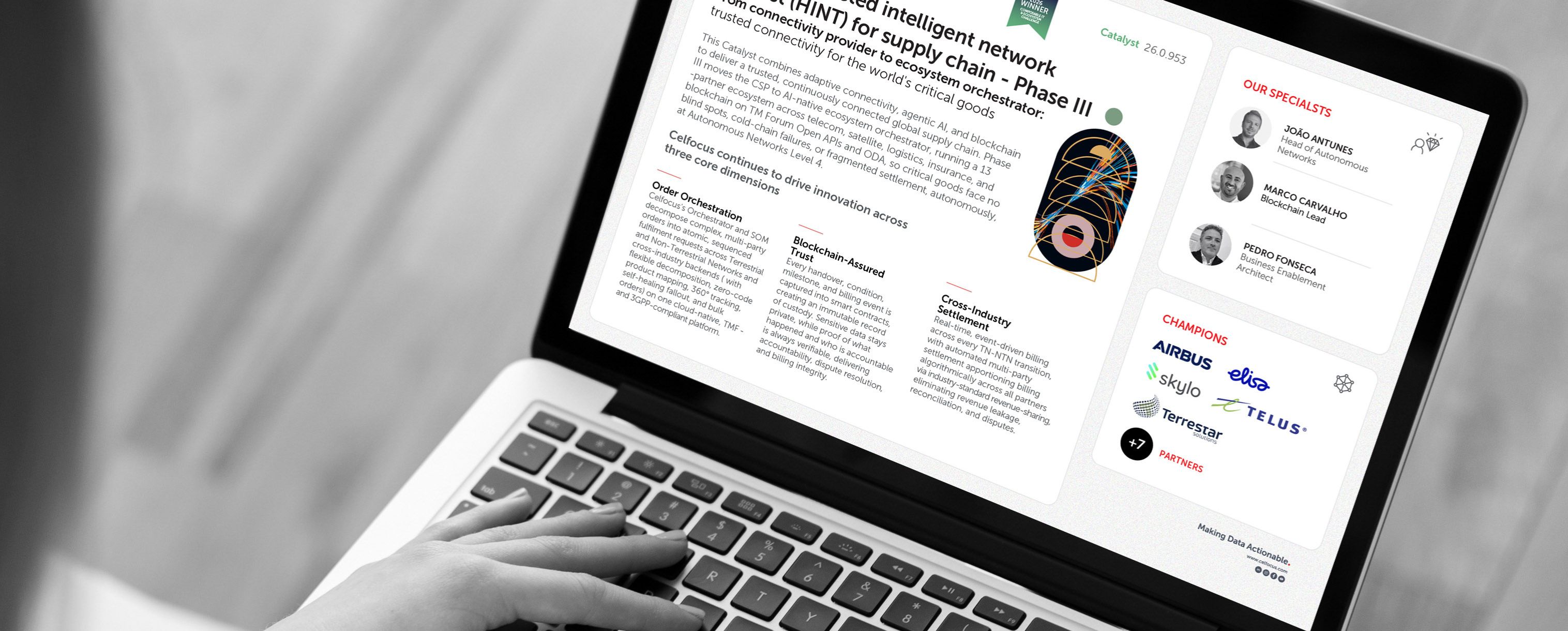
Our latest work in the TM Forum Catalyst program – specifically the project Hyperconnected Intelligent Network of Trust (HINT) for Supply Chain – shows what this looks like in practice. The solution combines powerful technologies in a new way, including:
The Invisible Engine: Why a good service orchestrator has never mattered more
First: provisioning across radically different networks: A supply chain shipment doesn't travel through a single network – it crosses terrestrial 4G/5G corridors, private 5G aboard cargo vessels, and multi-orbit satellite links, each with completely different characteristics, protocols, and management interfaces. Orchestration makes this invisible. A single order – placed in under 60 seconds – simultaneously configures SIM profiles, IoT device registrations, satellite bearers, and partner integrations across all domains in parallel. No manual handoff between network teams. No re-provisioning at domain boundaries. The complexity is absorbed by the platform, not pushed onto the operator.
|---Module:image|Size:Small---|

|---Module:text|Size:Small---|
Second, and more strategically important: a unified control plan for adaptive services: When conditions change mid-mission – a weather event, a satellite coverage gap, a contested transit zone – the orchestration layer doesn't just detect the problem. It acts. Slow-path orchestration handles non-time-critical resequencing through the full service stack; fast-path goes direct to domain controllers for immediate network-level response. The service adapts autonomously, while the customer only sees continuity.
Why does this matter more than ever?
Because networks are no longer homogeneous. The integration of NTN into 5G – formalised in 3GPP Release 17 – means CSPs are now expected to deliver services that span orbit classes, radio technologies, and ecosystem partners as a single coherent offer. In that world, orchestration isn't a backend concern. It is the product. Get it wrong and you don't have a service – you have a collection of pipes that occasionally talk to each other.
Blockchain as a multi-partner ecosystem trust enabler
Interoperability enables systems to connect and exchange data, but connection alone doesn't create trust. Without a shared framework for transparency and accountability, disputes and inefficiencies remain. This is where blockchain adds value.
As mentioned previously, the TM Forum Catalyst project HINT, with Celfocus's participation, demonstrates why a shared framework for trust is essential across complex ecosystems:
It's not only about moving traffic between networks. It's about moving trust across service providers, logistics actors, technology vendors, and end customers.
This fits naturally into the TM Forum Space ODA architecture, where reusable components support trust, interoperability, and orchestration across multi-party ecosystems. In industry language: next-generation communications meeting web3 principles – transparency without requiring a central authority.

|---Module:text|Size:Small---| Celfocus's role is to manage underlying complexity. We bring validated solutions from the telecom industry into the satellite domain. We help connect disparate systems, validate transactions, and accelerate innovation without adding unnecessary friction. We're not presenting blockchain, digital twins, or AI as buzzwords. We're presenting them as enabling layers for traceability, trust, and operational confidence – with measurable, value-added services by default.
The strongest opportunities ahead will come from services that combine communication, visibility, and assurance. The cold chain example illustrates it perfectly: a satellite is no longer just a communications link. It's part of a mission-critical chain where every handoff, every transfer, every decision matters. In those scenarios, blockchain isn't about novelty. It's about proving that a service behaves as expected, and that clients can rely on it.
|---Module:image|Size:Small---|

|---Module:text|Size:Small---|
The market we're building
The satellite industry is ready for a fundamental shift: from a technical market focused on reach, to a business market focused on trust. That market will reward companies that make satellite services not only technically sound, but also easy to trust, easier to operate, and ready to scale. The question isn't whether this shift will happen. It's happening now. The question is: who will build the trust layer first? At Celfocus, we believe we're uniquely positioned to help – and we're actively working with industry partners to unlock this opportunity.
|---Module:text|Size:Small---|