Let’s Talk


Oops! Something went wrong while submitting the form.

|---Module:text|Size:Small---| Agentic Network Operations applies coordinated autonomous agents, domain-aware AI and conversational interfaces to convert vast, noisy network telemetry into precise, explainable actions. By combining real-time ingestion, protocol aware correlation and Gen AI interpretation under a multi agent orchestrator, operators get faster root cause insight, safer automation and scalable diagnostics—bringing expert decisioning to every shift, site and incident.
Mobile users expect near-instant session establishment for data and voice: a tight sequence of request–response exchanges across multiple protocols must complete with minimal latency to support VoIP, video calls, gaming and other latency-sensitive services. Providers must deliver predictable session setup times, rapid visibility into degradations, and fast remediation to protect SLAs, reduce churn and contain operational costs.
The operational reality is far messier. Every session generates massive volumes of 3GPP tracing messages and probe data across S1AP, NAS, Diameter, SIP, RRC and other protocols. Traces must be correlated and stitched into per IMSI transaction paths, but IMSIs are often anonymized and telemetry is noisy. Scale and protocol diversity make automated monitoring and correlation difficult: elevated latency, missing responses and protocol errors are common yet hard to detect and root-cause across access, edge, core and cloud. Today diagnosis depends on scarce 3GPP specialists, producing slow triage, long MTTR and higher costs.
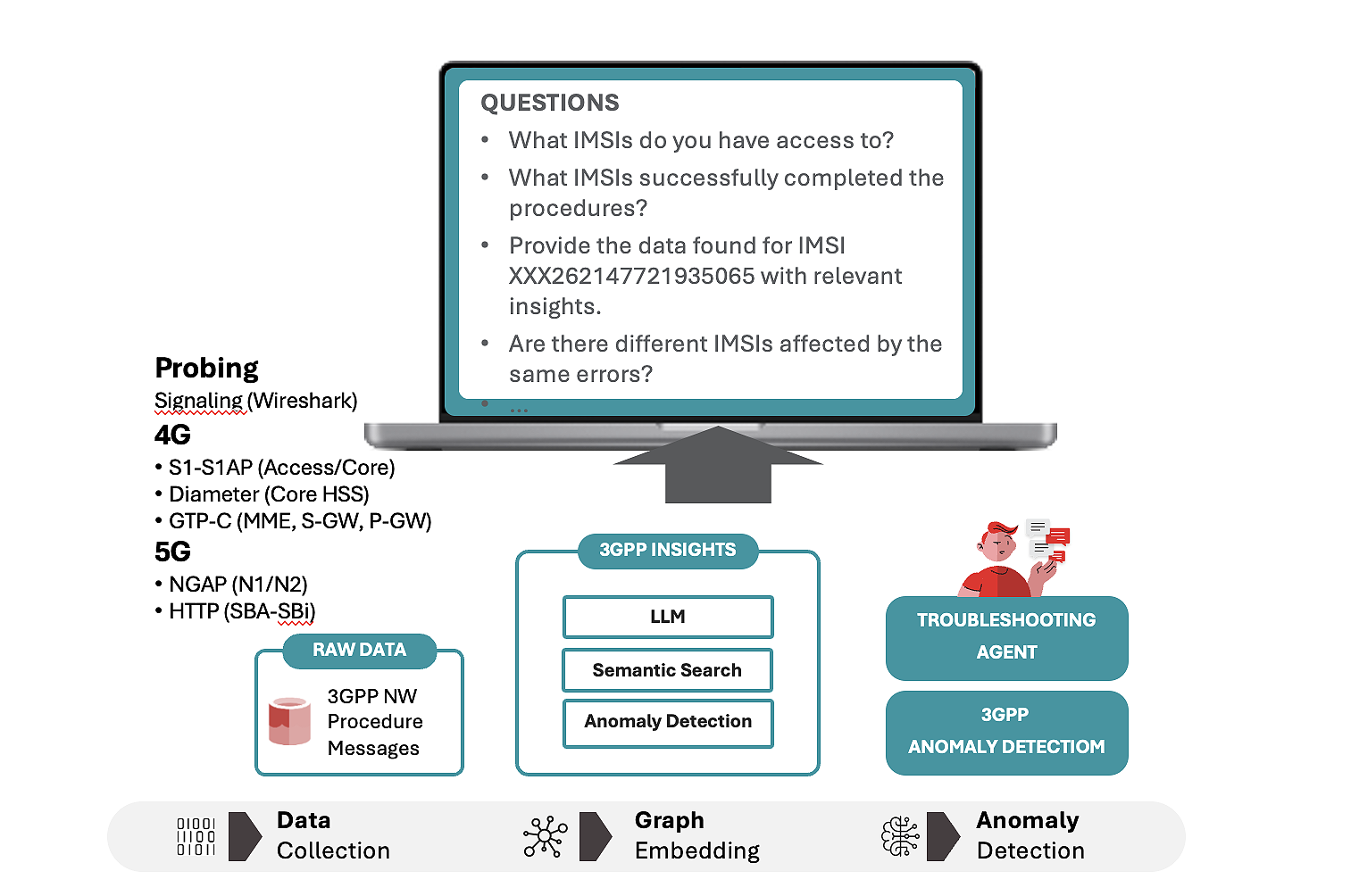
An agentic, Gen-AI–enabled platform transforms raw traces into actionable insight by combining domain-aware ingestion, path reconstruction, streaming anomaly detection and a multi-agent orchestration layer.
Key capabilities
|---Module:image|Size:Small---|
|---Module:text|Size:Small---|
Multi-agent orchestration
Central to the platform is a multi-agent design under a coordinating Orchestrator. Each specialized agent encapsulates focused telecom expertise and a compact toolset:
|---Module:image|Size:Small---|
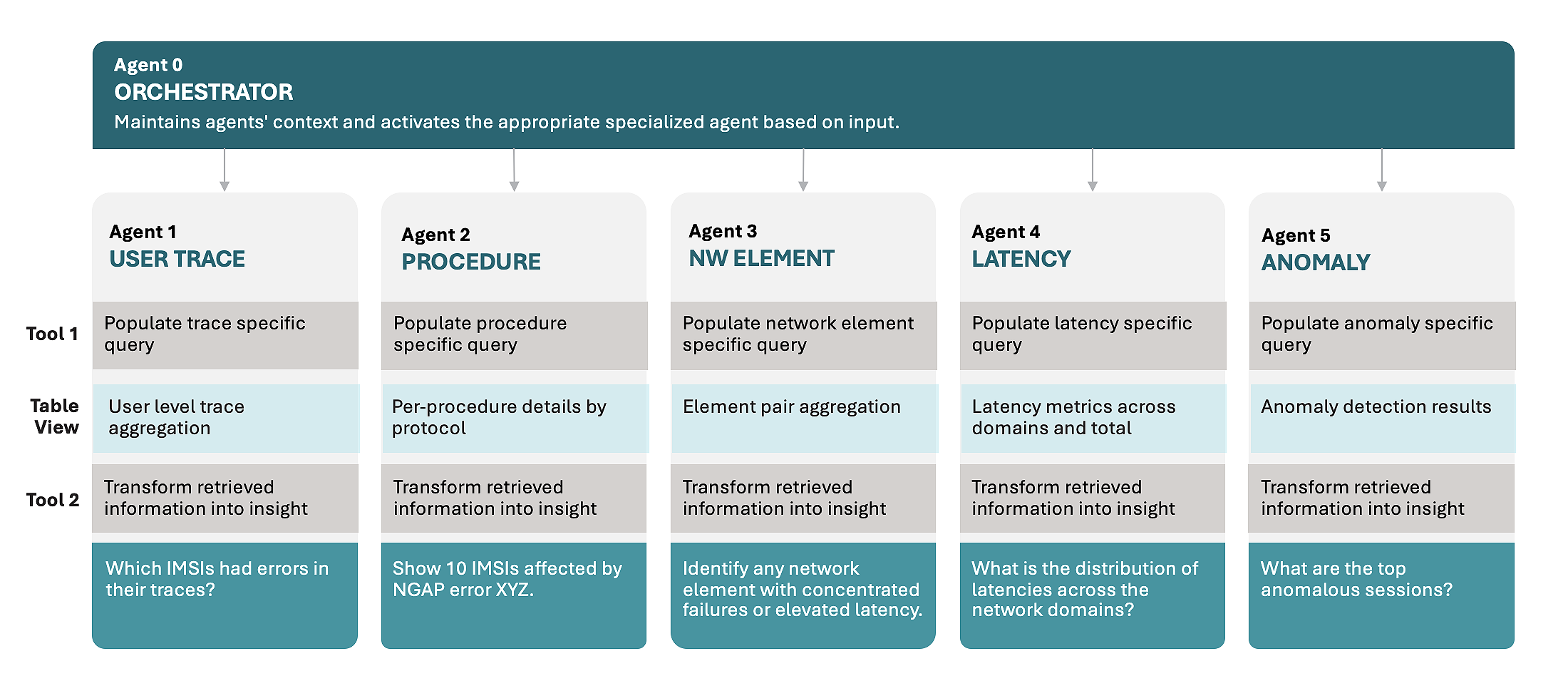
|---Module:text|Size:Small---| Agents return structured facts, confidence scores and semantic summaries. The Orchestrator composes these into a single actionable view: root cause hypotheses, targeted probe suggestions, remediation steps (traffic steering, QoS adjustments, VNF scale-out) and estimated business impact. Low-risk actions can be executed automatically under policy; higher-risk changes require operator approval. All actions and outcomes feed model and playbook updates.
The business impact is clear — these outcomes enable better use of expertise, measurable cost savings, and faster time-to-resolution.
Illustrative scenario
Consider a brief scenario: a surge in session setups in a city causes elevated Diameter latency and intermittent missing responses. The platform reconstructs per-IMSI paths from anonymized traces, detects the anomaly, and produces a semantic explanation and prioritized recommendations. An operator queries the system in natural language, reviews the suggested targeted probes and traffic-steering actions, approves execution, and the incident is mitigated in minutes rather than hours.
For service providers operating complex mobile networks, automated anomaly detection combined with Gen-AI–powered insight generation is no longer optional — it is a practical necessity to maintain predictable user experience, scale operations and reduce time and cost to resolution.
Agentic Network Operations is more than automation; it reframes how networks are monitored, diagnosed and healed — shifting value from manual firefighting to continuous assurance. By embedding specialist knowledge into lightweight agents, coupling them with Gen AI interpretation and preserving human oversight, providers can deliver predictable user experience at scale, cut costs, and accelerate innovation—turning operational complexity into a competitive advantage.