Let’s Talk


Oops! Something went wrong while submitting the form.
|---Module:text|Size:Small---| In recent years, the debate around the impact of Artificial Intelligence on the future of work has intensified. The question is no longer whether AI will transform work, but how quickly organisations will be able to adapt and harness its potential, while ensuring that their people remain at the centre of value creation.
The context is complex and the future uncertain. The only certainty is that it will be different. Given the speed and scale of the changes brought about by AI, generative AI and agentic AI, many jobs will become substantially different from those we know today.
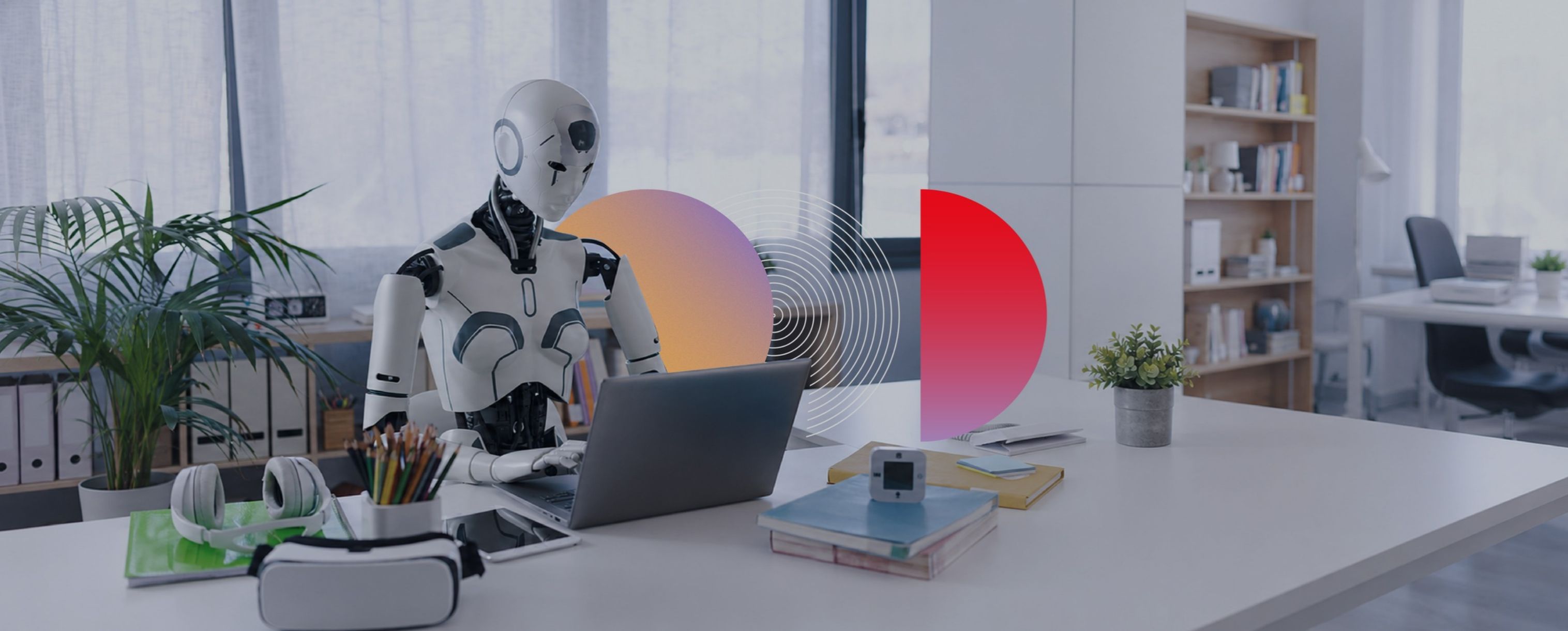
Perhaps this is not entirely new. The arrival of personal computers and the internet also brought disruption, uncertainty and expectations, but reality ultimately exceeded many predictions. Interestingly, human creativity has long anticipated these scenarios. Films such as I, Robot, released in 2004 and set in 2035, now seem less like fiction and more like a possible reflection of the present.
More than a technological evolution, we are facing a profound shift in how work is designed. Organisations are becoming ecosystems in which people and technology, including Artificial Intelligence agents, coexist and collaborate. This collaboration raises new questions.
At a time when systems already process millions of data points, interpret them across different contexts, produce content, make decisions and generate recommendations, the principle of keeping humans in the loop becomes increasingly relevant. But are we prepared to play that role?
Validating, challenging and taking responsibility for what technology produces requires more than supervision. The further we move towards automation, the more decisive human skills become. These include critical thinking, decision-making and communication, as well as curiosity, creativity, adaptability and empathy.
Curiosity acts as a driver for challenge and constructive opposition. Creativity becomes a lever for disruption and innovation. Adaptability fuels continuous learning. Empathy provides an anchor for understanding impact, context and people.
This raises a central question: how can we equip people to remain relevant in a world of accelerated and disruptive change?
The labour market appears to be adjusting, but not in a coordinated way. Organisations are looking for more experienced talent, capable of dealing with complexity, uncertainty and ambiguity. At the same time, young people continue to enter the labour market without being fully prepared for these demands.
Academic institutions are trying to adapt to their curricula, but not at the same pace as the transformation. This creates a dilemma. If companies increasingly recruit fewer junior professionals, how can young people gain experience and progress? How can talent be developed without opportunities to get started?
This may be one of the major paradoxes of our time. While we talk about talent shortages, we may also be creating barriers to developing that very talent.
Against this background, perhaps the question is not whether Artificial Intelligence will replace people, but how we will redefine their role. What balance do we want between automation and human contribution? Which skills will we value? And how can we ensure that no one is left behind at a time when everything is accelerating?
Artificial Intelligence creates new opportunities and many challenges, technological, environmental and, above all, human. More than answers, this may be a moment that demands better questions.
I would like to share some recent references from the IT services sector that support this reflection. Taken together, they show that technology alone is not enough. Although AI is dramatically expanding the scope of automation, from highly productive human-AI teams to trillions of dollars’ worth of work activities, sustainable value will depend on organisations’ ability to adapt their people strategies, reskill talent and redesign human work.
According to Mohamad Ali, Senior Vice President and Head of IBM Consulting, in A New Way to Make AI Actually Work in the Real World, published in May 2026, IBM points to a future of work built around small, agile teams augmented by AI, capable of achieving significantly higher levels of productivity than traditional models.
The idea of “humans and digital working together as a team, by design” reinforces a clear trend. Leading AI companies are not simply adopting technology. They are redesigning roles, teams and delivery models.
Cognizant’s report New Work, New World 2026, published in January 2026, presents a broader view of AI’s impact on work, suggesting that almost every job will be affected. However, it makes clear that the greatest gains will depend on people’s development through reskilling, continuous learning and there definition of roles.
The future of work will therefore combine intelligent automation with the recognition and development of human capabilities.
The final reference I would like to highlight is Deloitte’s 2026 announcement, From Ambition to Activation: Organizations Stand at the Untapped Edge of AI’s Potential. The associated report, The State of AI in the Enterprise, describes a future in which AI becomes ubiquitous across job functions, requiring human-in-the-loop strategies.
The message is clear. The future of work will depend on combining technological efficiency with human creativity, supported by cultural change, organisational adaptation and skills development.
We are at a point where technology amplifies, but does not replace, what is essential. The next step is clear: invest in skills, redesign roles and ask better questions, before change answers for us.