Let’s Talk


Oops! Something went wrong while submitting the form.
|---Module:text|Size:Small---|
Digital transformation is redefining the way companies engage with their customers, requiring more agile, integrated operations that can respond in real time to market expectations. In this context, process simplification, automation and artificial intelligence play a central role in building more consistent and efficient experiences.
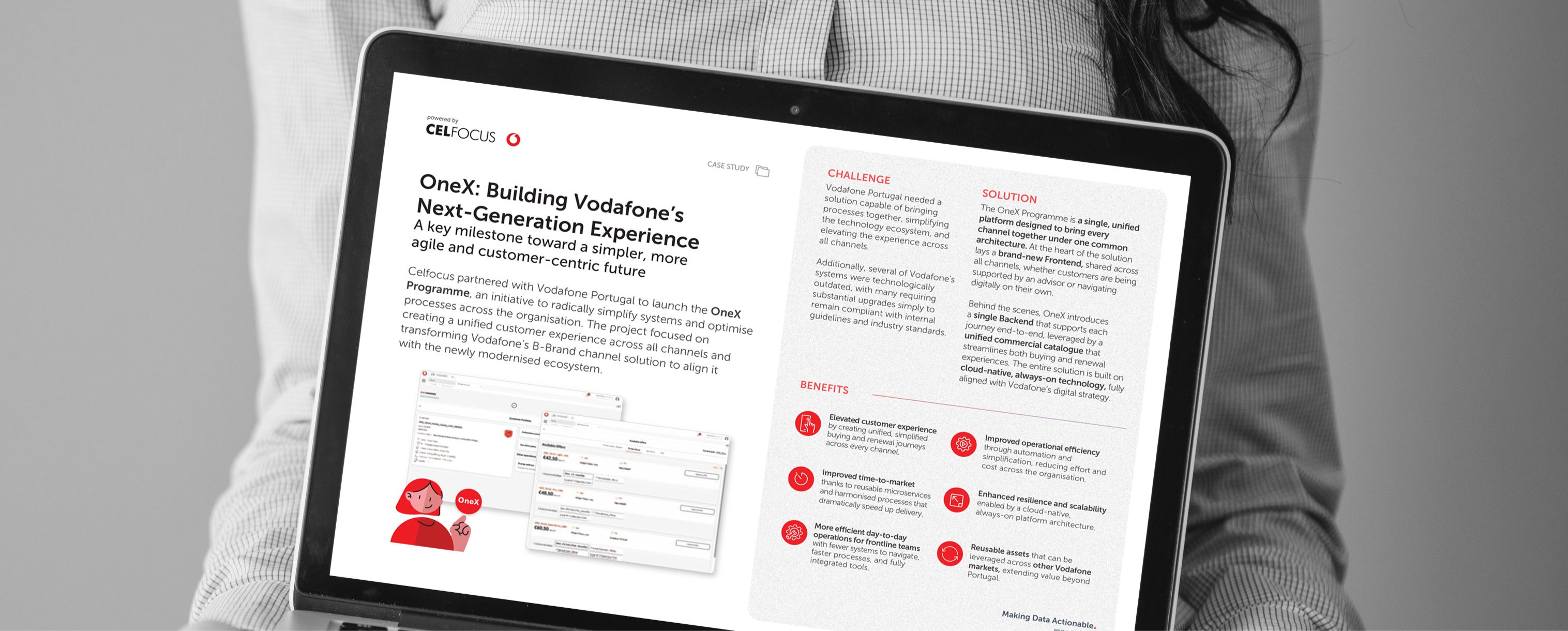
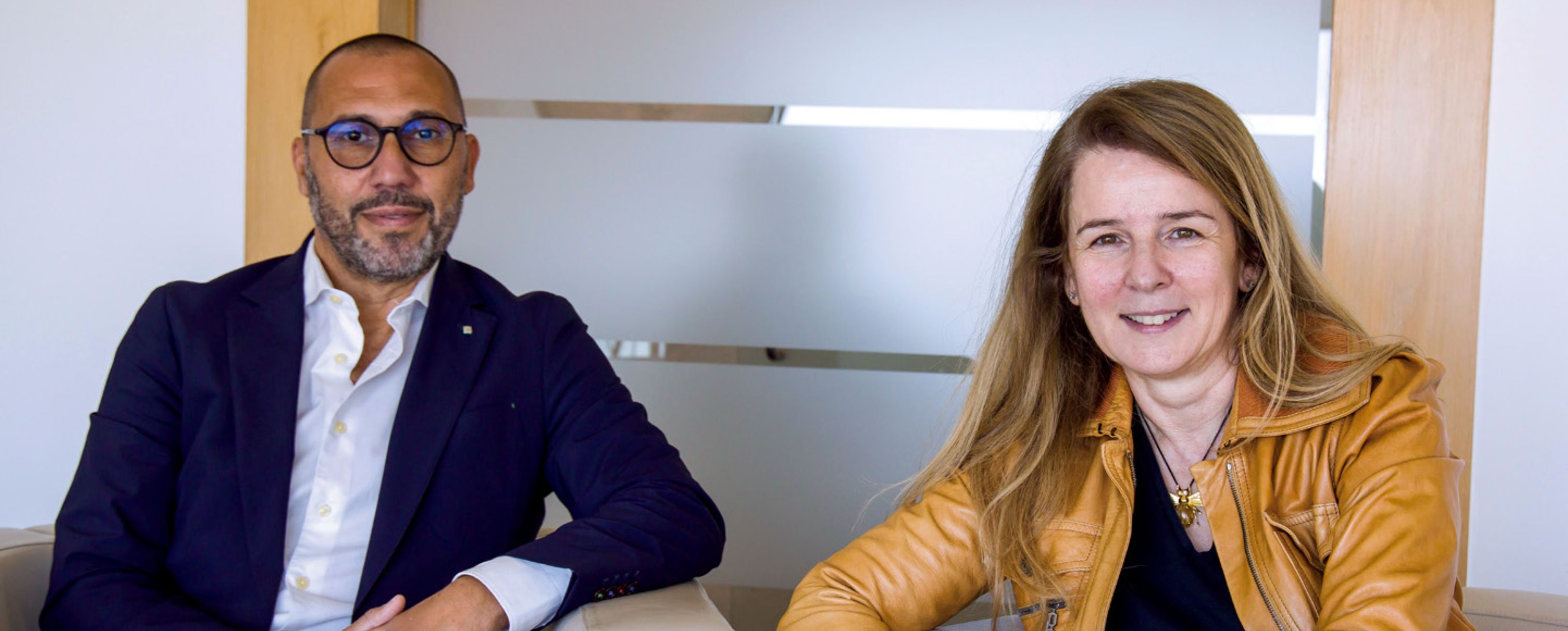
Celfocus invited Luísa Pestana, Board Member at Vodafone Portugal responsible for Commercial Transformation and Operations, and João Teixeira, CIO of Vodafone Portugal, to talk to Executive Digest about how the OneX project is transforming the company’s operations, the challenges overcome and the strategic impact of this new technological foundation on the organisation’s future.
Here’s the full interview transcription:
In a sector where customers are increasingly demanding in terms of speed and consistency, what operational challenges did Vodafone Portugal identify that justified the launch of the OneX project?
Luísa Pestana (LP): Vodafone has always been known for innovating and for placing the customer at the centre of everything it does. OneX is a natural continuation of that strategy. Today, customers expect the same experience across all contact channels with companies, and they want simple, very fast journeys. As part of this evolution, we proactively adapted to these demands. We also prepared new journeys with more advanced mechanisms, for a transformation that integrates artificial intelligence with components such as AI agents. The goal remains the same as ever: to serve the customer as effectively and quickly as possible.
João Teixeira (JT): The transformation Luísa refers to requires the systems architecture to move, so to speak, hand in hand with this change. We also need to design it to accommodate future developments that may be required, so that it does not become limited over time, for example in terms of security or data protection. Essentially, we are moving from monolithic systems to modular systems. In other words, systems are built in blocks, with the functionalities required at each moment, integrating what makes the most sense for the service we want to provide to customers.
OneX is presented as a single platform to consolidate channels, processes and business logic. What transformation does this represent compared with the previous model?
JT: Today’s business, with customers who are more informed and more demanding in their relationship with companies, requires a different response capability, and that demands greater flexibility from everyone. The model we are implementing at Vodafone is more flexible and agile, with a much more visible digital component, enabling us to standardise patterns across commercial and service transactions, whether in assisted or unassisted channels.
When discussing the standardisation of the experience across digital and assisted channels, what were the main friction points Vodafone sought to address?
LP: The main friction points lie in the lack of continuity in the experience of Vodafone’s different customer contact channels. The same process could involve different journeys and different systems and often required operations to be repeated whenever several channels were involved. By consolidating systems and standardising the execution logic, OneX is ensuring that the journey is continuous and consistent, regardless of the channel used by the customer.
The operational gains announced are significant, from reducing commercial journey times to decreasing operational errors. What practical impact do these results have on day-to-day operations?
LP: The impact is very direct, particularly on the daily dynamics of the teams. When we reduce journey times to just a few minutes, we significantly increase service capacity and improve response times for customers. At the same time, by reducing errors and repetition of operations, we gain greater reliability and become less dependent on subsequent corrections. The final gain is clear: greater operational optimisation and more consistency in the execution of commercial activities.
OneX was developed by Celfocus to address concrete challenges in Vodafone’s operations. What weighed most in the choice of this technology partner for a project of this scale?
JT: The choice of Celfocus was aligned with the need to address a structural challenge, not merely a technological one. Celfocus’ experience in highly complex environments and its simplification-oriented approach was decisive. The project required the ability to consolidate systems, eliminate redundancies, and design a single architecture with measurable business impact. Co-creation between the Celfocus and Vodafone teams made it possible to ensure that the solution responded directly to operational needs, rather than simply being a technological exercise.
In a programme of this complexity, involving operational transformation and technological integration, what were the main implementation challenges and what role did Celfocus play in overcoming them?
JT: The main challenge was simplifying the existing systems state, accumulated over time, without compromising operational continuity. This meant integrating systems, aligning processes, and redesigning the way the organisation carries out its activities. Celfocus played a central role in structuring this transition, ensuring technological and operational convergence and making sure that simplification translated into real gains, not just conceptual ones.
This type of transformation also requires internal adoption. How was the adoption of OneX managed among commercial, customer service and other teams across the organisation?
LP: Let us be clear,without internal adoption, there is no transformation. To get OneX moving, we had to evangelise change, onboard the commercial teams, and involve the teams that would benefit from the transformation. True transformation requires cultural adoption. It requires making the business benefits clear. And it must happen while the organisation continues to operate, because the business does not stop. At the end of the day, this is not just a technological change. Transformation has a cross-cutting impact on the organisation and customer experience, which is critical to the business.
Automation is one of the pillars of the project. To what extent does this evolution free up teams for higher value-added tasks?
JT: Automation and the introduction of artificial intelligence agents have a structural impact on the way work is distributed. By automating up to 90% of processes, we significantly reduce the burden of repetitive and operational tasks. This allows teams to focus on activities that require greater human input, such as customer interaction, offer personalisation and the commercial component, where they are able to add more value.
OneX appears to go beyond simple technological modernisation, directly touching Vodafone Portugal’s operational strategy. To what extent has this project changed the way the organisation thinks about customer experience management?
LP: OneX has led us to think about customer experience in an even more integrated way. We started by analysing current customer needs and what customers are looking for when they interact with Vodafone, whether on commercial or service journeys. Based on those insights, we mobilised the organisation to operate on a single foundation. As a result, Vodafone is now fully focused on ensuring that every customer experience is designed transversally, so that it is consistent across all the channels with which the customer may interact.
The fact that OneX can be replicated in other Vodafone Group markets means that this project goes beyond local need. What strategic significance does this have for the organisation?
JT: The replicable nature of OneX does indeed show that the project was designed from the outset as a strategic asset, not merely as a local solution. By enabling adaptation to other markets, it has created a common foundation that can be scaled within Vodafone Group, accelerating transformation processes.
In a market where time-to-market is increasingly critical, what competitive advantages come from having a simpler architecture and a more flexible technological foundation?
JT: Simplified architecture reduces dependence on legacy systems and the technical complexity associated with change. This makes it possible to introduce new services, adapt offers, or implement changes with less effort and greater speed. In an industry where response time is decisive, this agility in execution is a clear advantage.
OneX has created a new operational foundation for Vodafone. What opportunities does this transformation now open in terms of innovation, new services or the evolution of customer experience?
LP: With a single, reusable foundation, Vodafone can now evolve continuously without reintroducing complexity. The ability to reuse components accelerates the development of new services and enables a more consistent evolution of customer experience. The natural next step will be to transition from commercial journeys to service journeys that are even closer to customers’ needs, taking advantage, at an even more significant level, of the potential of artificial intelligence.