Let’s Talk


Oops! Something went wrong while submitting the form.

|---Module:text|Size:Small---| Telecom operators are living in an unprecedented pressure cooker. The race to monetise 5G, support explosive IoT growth, and deliver seamless omnichannel customer experiences requires an IT backbone that is simultaneously agile and bulletproof. Yet, for decades, the massive complexity of managing legacy BSS and OSS transformations has been handled through brute force by constantly scaling human effort. We added more validation layers, enforced more manual checks, and embedded highly specialised, siloed roles across the Software Development Lifecycle (SDLC).
While this methodology historically kept systems stable, it simply does not scale anymore. It buckles under the demands of modern digital platforms. This is especially true for high-availability environments like real-time charging, streaming ecosystems, and digital TV platforms where zero-downtime is a strict baseline.
The emergence of Generative AI initially promised a silver bullet. Yet, looking across the telecom industry today, much of the sector remains stalled in what we call the “chatbot phase.” Organisations are celebrating marginal gains from off-the-shelf productivity tools and standard code copilots, rather than fundamentally rethinking how enterprise software is integrated and engineered.
At Celfocus, we recognised early on that passive, prompt-reliant AI assistance is not enough. The true value for a telecom operator does not lie in writing isolated syntax marginally faster. It lies in rewriting the entire economics of complex system integration.
Shifting the integration paradigm: the “transformation boosters”
To deliver structural, bottom-line impact for telecom operators, an AI framework cannot exist as a separate dashboard or a fragmented set of tools. It must be industrialised.
As shown in our operational blueprint, Celfocus has grouped these advanced capabilities into four distinct Transformation Boosters. These are Delivery Acceleration, Cloud Reliability, Operations Intelligence, and Security & Compliance.
Rather than chasing abstract engineering metrics, this structured framework focuses strictly on answering the critical questions facing today’s CTOs and Heads of BSS/OSS: How do we compress time-to-market? How do we lower integration costs? And how do we reduce our dependency on scarce, costly technical resources?
|---Module:image|Size:Small---|
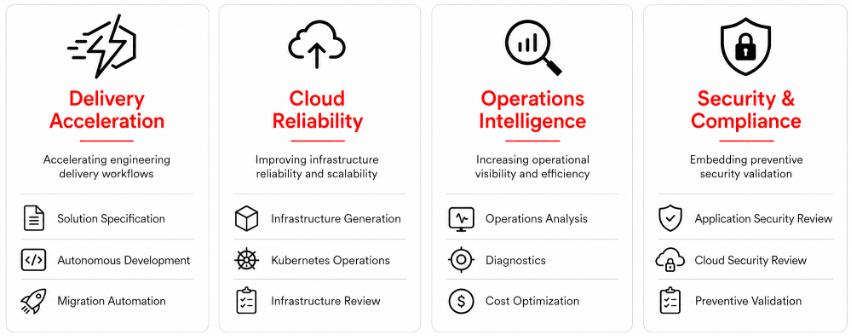
|---Module:text|Size:Small---|This is not a theoretical roadmap. Out of sixteen distinct ecosystem capabilities identified across these boosters, 70% are already fully developed or in active production deployment. By embedding these stateful, context-aware AI agents directly into standard development environments, repositories, and CI/CD pipelines, we are moving past the copilot plateau into true, governed autonomy.
Tangible business impact - what changes for the operator?
When evaluating agentic frameworks, a telecom executive’s natural question is simple: For my organisation, concretely, what changes?
Through live deployments of our proprietary framework with a Tier 1 European telecom operator, we have moved past speculative percentages. We are now delivering measurable, industrialised business value across three flagship capabilities.
Codifying seniority to mitigate resource scarcity
Perhaps the most strategic advantage of an agent-driven integration framework is its ability to encode hard-won domain experience.
Elite telecom architects and senior engineers are scarce, expensive, and difficult to scale. They are the ones who understand the delicate trade-offs between latency and throughput. They anticipate cascade failure modes across complex microservices, and they know how to safely decouple legacy monoliths without disrupting live services.
By codifying this senior mindset into specialised technical lead agents, Celfocus is able to scale top-tier delivery consistency uniformly across all delivery teams and offshore locations without creating manual review bottlenecks. These agents perform advanced, context-aware architecture reviews, verify system topology alignment, and identify systemic risks like potential database deadlocks under peak load long before human QA teams would catch them.
Furthermore, we are actively bridging this capability into the operational phase. Our roadmap includes leveraging these agents within the Operations Intelligence and Cloud Reliability boosters to monitor runtime environments, perform FinOps cost optimisation analyses, and identify infrastructure defects before they cause live service outages.
Industrialised trust: human-in-the-loop governance
Despite these advanced capabilities, fully autonomous software engineering is neither practical nor desirable in high-stakes telecom environments. A strict Human-in-the-Loop model remains a foundational tenet of our day-to-day operations.
AI agents act as powerful force multipliers, but experienced engineers retain absolute accountability for validation, final approvals, and strategic architectural direction. This rigorous governance framework completely eliminates risks like model hallucinations and allows our delivery teams to continuously refine the agents based on evolving on-the-ground domain expertise. Trust, in this ecosystem, is not assumed. It is rigorously engineered.
Conclusion: moving beyond the chatbot phase
What Celfocus has operationalised is not an incremental productivity hack for developers. It is a proven blueprint for the future of telecom system integration.
By combining deep telecom domain expertise with a live, industrialised agentic framework, we are fundamentally redefining the relationship between complexity, speed, and cost. The goal was never simply to write code faster. It was to build an intelligent, capability-driven ecosystem that allows operators to eliminate delivery friction, de-risk massive migrations, and scale expertise consistently.
As the demands on digital infrastructure continue to accelerate, frameworks like this are moving rapidly from a competitive advantage to an operational necessity. For telecom operators looking to lead the next generation of digital services, moving past the chatbot phase is no longer optional. It is the new baseline for survival.